

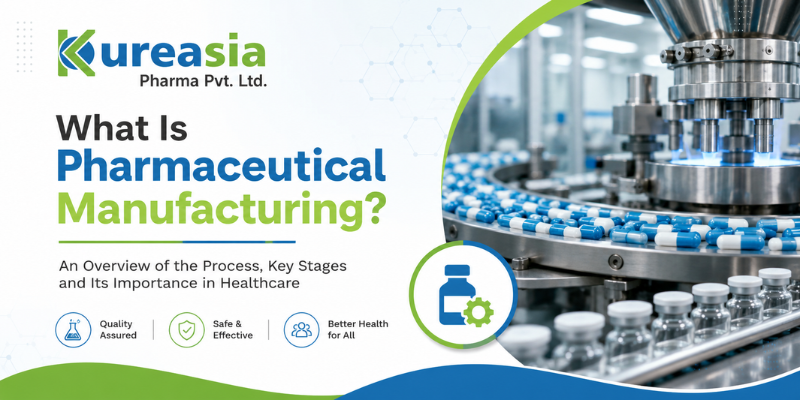
Pharmaceutical manufacturing is the controlled process of converting active pharmaceutical ingredients (APIs) and other approved ingredients into finished medicines such as tablets, capsules, syrups, creams, and other dosage forms.
The process involves much more than simply mixing ingredients. Pharmaceutical manufacturers must control raw materials, production processes, testing, packaging, documentation, and storage to help ensure consistent product quality and safety.
What Does Pharmaceutical Manufacturing Involve?
| Stage | What Happens |
|---|---|
| Raw Material Sourcing | APIs and other approved materials are procured and checked |
| Manufacturing | Ingredients are processed into the required dosage form |
| Quality Testing | Samples are tested against defined specifications |
| Packaging | Finished medicines are packed and labelled appropriately |
| Batch Release | Quality records and test results are reviewed before release |
Main Steps in Pharmaceutical Manufacturing
1. Raw Material Selection
Manufacturing begins with approved raw materials, including the active pharmaceutical ingredient (API) and necessary excipients.
Materials are received, identified, and evaluated according to established specifications before they are used in production.
2. Dispensing and Weighing
Required ingredients are accurately weighed according to the approved manufacturing formula.
Accurate weighing is important because variations in ingredient quantities can affect the consistency of the finished product.
3. Manufacturing and Processing
The materials are processed according to the dosage form.
For example, tablet manufacturing may involve blending, granulation, compression, and coating, while liquid medicines require controlled mixing and filling processes.
4. In-Process Quality Checks
Quality checks are performed during manufacturing rather than waiting until the end.
Depending on the product, checks may include weight variation, appearance, physical properties, fill volume, or other relevant parameters.
5. Finished Product Testing
After manufacturing, representative samples of the finished batch are tested against predefined specifications.
Testing requirements depend on the medicine and may include parameters such as identity, assay, dissolution, microbial quality, and stability-related characteristics.
6. Packaging and Labelling
Approved products are packed using suitable packaging materials.
Packaging helps protect medicines from factors such as moisture, light, contamination, and physical damage while providing important product information.
7. Batch Review and Release
Manufacturing and quality records are reviewed before a batch is released for distribution.
Only batches that meet the applicable specifications and quality requirements should proceed to the next stage.
Different Types of Pharmaceutical Dosage Forms
| Dosage Form | Common Manufacturing Approach |
|---|---|
| Tablets | Blending, granulation, compression and, where required, coating |
| Capsules | Powder or granule preparation followed by capsule filling |
| Syrups | Controlled mixing, filtration where applicable, and liquid filling |
| Creams | Controlled mixing or homogenization followed by filling |
| Ointments | Heating/mixing or other controlled processing followed by filling |
| Gels | Mixing and controlled gel formation followed by filling |
The manufacturing method is selected according to the formulation and product requirements.
Why Is Quality Control Important?
Quality control helps confirm that medicines meet established specifications before they are released.
A pharmaceutical manufacturer may use laboratory testing and in-process controls to evaluate the identity, strength, purity, performance, and other relevant characteristics of a product.
Quality assurance (QA) is broader than laboratory testing. It includes the systems and procedures used to ensure that manufacturing and quality activities are properly controlled and documented.
Quality Control vs Quality Assurance
| Quality Control (QC) | Quality Assurance (QA) |
|---|---|
| Focuses on testing and inspection | Focuses on the overall quality system |
| Tests raw materials and finished products | Controls processes, procedures and documentation |
| Helps identify whether specifications are met | Helps prevent quality problems through controlled systems |
| Includes laboratory activities | Covers a broader range of manufacturing and quality activities |
What Is GMP in Pharmaceutical Manufacturing?
Good Manufacturing Practice (GMP) refers to principles and requirements designed to help ensure medicines are consistently produced and controlled according to appropriate quality standards.
GMP covers areas such as:
- Personnel and training
- Manufacturing facilities
- Equipment
- Sanitation and hygiene
- Documentation
- Raw material controls
- Production procedures
- Quality testing
- Batch records
- Storage and handling
For pharmaceutical businesses, a strong GMP-based manufacturing system is an important part of maintaining consistent product quality.
Pharmaceutical Manufacturing in India
India has a large pharmaceutical manufacturing sector serving both domestic and international markets.
Indian pharmaceutical manufacturers and exporters may supply finished formulations such as tablets, capsules, syrups, creams, ointments, and gels to international buyers, depending on their product portfolio, approvals, and market requirements.
For international supply, manufacturers must also consider the applicable requirements of the destination country in addition to their manufacturing and quality systems.
How Does Pharmaceutical Manufacturing Support Global Supply?
Reliable manufacturing helps pharmaceutical companies maintain consistent production and supply for distributors, importers, healthcare organizations, and other qualified buyers.
A well-managed manufacturing operation combines:
Quality Systems + Manufacturing Infrastructure + Testing + Documentation + Supply Management
Together, these elements help create a more controlled pharmaceutical supply chain.
Frequently Asked Questions
01.What is pharmaceutical manufacturing?
Pharmaceutical manufacturing is the controlled production of medicines from APIs and other approved ingredients into finished dosage forms such as tablets, capsules, syrups, creams, and gels.
02.What are the main stages of pharmaceutical manufacturing?
The main stages generally include raw material control, dispensing, manufacturing, in-process testing, finished-product testing, packaging, documentation review, and batch release.
03.Why is GMP important in pharmaceutical manufacturing?
GMP provides a structured framework for controlling manufacturing and quality processes so medicines can be consistently produced and controlled according to applicable quality requirements.
04.What is the difference between pharmaceutical manufacturing and pharmaceutical packaging?
Manufacturing involves producing the medicine itself, while packaging involves placing the finished product into appropriate containers and providing required labelling and protection.
05.Are all medicines manufactured in the same way?
No. Manufacturing methods vary according to the formulation, dosage form, ingredients, equipment, and product specifications.
06.What dosage forms can pharmaceutical manufacturers produce?
Depending on their facilities and product portfolio, manufacturers may produce tablets, capsules, syrups, creams, ointments, gels, and other dosage forms.
Looking for a Pharmaceutical Manufacturing Partner?
Kureasia Pharma provides pharmaceutical manufacturing and export support for qualified business requirements, with capabilities covering tablets, capsules, liquid syrups, ointments, gels, and creams.
If you are looking for pharmaceutical manufacturing, bulk supply, or international export support, share your product requirements with the Kureasia Pharma team.